


In a world where technology constantly pushes boundaries, Microsoft’s HoloLens stands out as a game-changer in augmented reality. This innovative headset merges the digital and physical realms, allowing users to interact with holograms in real time. From gaming to healthcare and architecture, its applications are transforming industries and redefining how people experience their environments.
As businesses and developers explore the potential of HoloLens, it’s clear this device isn’t just a novelty; it’s a powerful tool for enhancing productivity and creativity. By bridging the gap between virtual and tangible, HoloLens offers a glimpse into the future of human-computer interaction. Dive into the fascinating world of HoloLens and discover how it’s shaping the way we see and engage with the world around us.
Overview of HoloLens
HoloLens represents a significant advancement in augmented reality technology, blending digital and physical environments seamlessly. Users interact with holograms in real-time, enhancing experiences across diverse fields.
Key Features
- Mixed Reality Experience: HoloLens captures the surroundings, overlaying digital content without interrupting the user’s environment.
- Spatial Mapping: The device utilizes sensors to understand physical spaces, allowing applications to adapt to real-world layouts.
- Natural User Interface: HoloLens supports gestures, voice commands, and eye tracking, facilitating intuitive interactions.
Applications
- Gaming: HoloLens enables immersive gameplay that integrates virtual elements into players’ surroundings, enhancing engagement.
- Healthcare: Medical professionals can visualize complex data, aiding diagnosis and surgical procedures through augmented information.
- Architecture: Architects use HoloLens to present 3D models on-site, providing clients with a better understanding of design concepts.
Technical Specifications
| Specification | Details |
|---|---|
| Display | High-definition holographic display |
| Processor | Custom-built Holographic Processing Unit |
| RAM | 4 GB |
| Battery Life | 2-3 hours of active use |
| Connectivity | Wi-Fi, Bluetooth |
HoloLens isn’t just a sophisticated gadget; it’s a transformative tool shaping interactions in modern industries. Its potential to redefine how people engage with information is significant.
Key Features of HoloLens
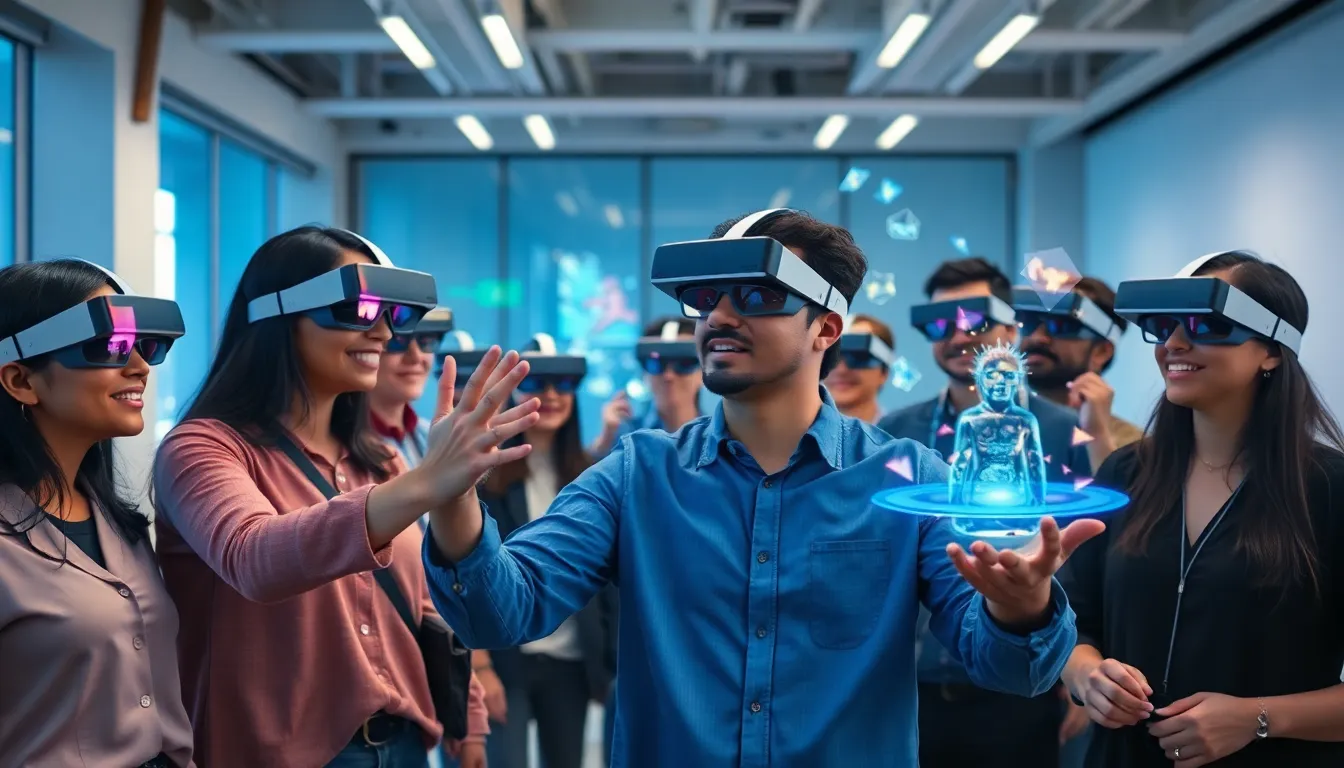
HoloLens showcases several advanced features that enhance its functionality in various applications. These features support seamless integration of digital and physical environments.
Mixed Reality Technology
Mixed reality technology creates an immersive environment by overlaying holographic images onto the real world. This technology utilizes advanced sensors and depth perception to merge virtual objects with physical surroundings. HoloLens incorporates spatial mapping, enabling accurate interaction with objects and surfaces. Users experience realistic environments, as the headset recognizes room layouts and positions digital content accordingly. This adaptability allows for diverse applications, from gaming to complex medical simulations.
User Interface and Experience
HoloLens employs a natural user interface that enhances interactivity. Gesture recognition enables users to manipulate holograms fluidly, while voice commands facilitate hands-free operation. Eye tracking enhances navigation, allowing users to select or interact with items simply by looking at them. This intuitive design promotes a user-friendly experience, making it accessible for various skill levels. Users can engage with applications in an organic manner, further amplifying productivity and creativity across industries.
Applications of HoloLens
HoloLens serves a diverse range of applications across several industries, advancing practices and methodologies while enhancing user experiences.
In Healthcare
HoloLens significantly transforms healthcare through precise medical visualization and immersive training. Surgeons use the device to overlay vital data during procedures, improving accuracy and decision-making. Medical students benefit from simulated surgeries, allowing for hands-on practice in a safe environment. Notable studies show that HoloLens enhances understanding of complex anatomical structures, leading to better educational outcomes (source: Journal of Medical Education). These applications ensure that healthcare professionals provide superior patient care with advanced technological support.
In Education
HoloLens revolutionizes the educational landscape by facilitating experiential learning. Educators use mixed reality to create interactive lessons, enabling students to engage with 3D models of historical artifacts or biological processes. Enhanced realities promote collaborative projects, allowing learners to experiment in real-time. Research indicates that students retain 75% of information when engaged with interactive elements, compared to traditional methods (source: Educational Research Review). HoloLens enriches the educational experience, making learning more effective and enjoyable.
In Industry
HoloLens enhances industrial processes by streamlining operations and fostering collaboration. Workers utilize the headset for real-time data visualization, leading to improved efficiency in manufacturing and maintenance tasks. Engineers can visualize 3D models on-site, facilitating better problem-solving without excessive downtime. Companies report a 30% increase in productivity when adopting HoloLens technology (source: Industry Week). This innovative approach allows industries to operate with heightened accuracy, ultimately driving advancements in various sectors.
Comparison with Competitors
HoloLens competes with several notable augmented reality (AR) devices, each offering unique features and capabilities.
Magic Leap 1
Magic Leap 1 emphasizes spatial computing, enabling users to interact with digital content in their real-world environments. Its light-weight design enhances comfort for extended use. With a field of view of approximately 50 degrees, Magic Leap 1 offers an immersive experience but lacks the expansive field of view found in HoloLens. The device’s advanced dynamic lighting creates realistic shadows and reflections, though HoloLens’s mixed reality technology ensures more seamless integration with surrounding environments.
Meta Quest Pro
Meta Quest Pro focuses on virtual reality with robust AR capabilities. Unlike HoloLens, it features a fully immersive experience but primarily emphasizes gaming and social interactions. Its eye tracking and facial expression recognition add layers of interaction unavailable in HoloLens. However, Quest Pro’s reliance on external sensors for more immersive experiences can complicate setup, unlike HoloLens’s self-contained system.
Google Glass Enterprise Edition 2
Google Glass Enterprise Edition 2 targets enterprise applications with hands-free access to information. Its lightweight frame and augmented reality features allow seamless integration into workflows. Unlike HoloLens, it offers a limited AR experience with a focus on showing information rather than immersive interaction. HoloLens’s superior holography and spatial mapping capabilities provide more advanced applications in sectors like healthcare and architecture.
Vuzix Blade
Vuzix Blade supports AR through a smart glass format, offering a transparency feature that overlays digital information onto the physical world. While it provides utility in specific business applications, the overall functionality and graphical capabilities fall short compared to HoloLens. Vuzix Blade’s interface tends to be less intuitive, lacking the gesture and voice control features prevalent in HoloLens.
Apple Vision Pro
Apple Vision Pro, while not yet released, is positioned as a significant competitor. Expected features include high-resolution displays and extensive software integration that enhances augmented experiences. HoloLens’s integration within diverse professional environments may maintain its edge until Vision Pro demonstrates real-world applications. HoloLens remains pivotal in sectors like healthcare and education, showcasing practical and transformative uses not yet matched by potential competitors.
HoloLens stands out as a groundbreaking tool that reshapes how industries operate. Its ability to blend digital and physical worlds fosters innovative solutions that enhance productivity and creativity. As various sectors embrace this technology, the potential for immersive experiences continues to expand.
With its advanced features and user-friendly interface, HoloLens not only improves workflows but also transforms learning and collaboration. As it leads the charge in augmented reality, it’s clear that HoloLens is more than just a headset; it’s a catalyst for change in how professionals engage with their work and the information around them.


