
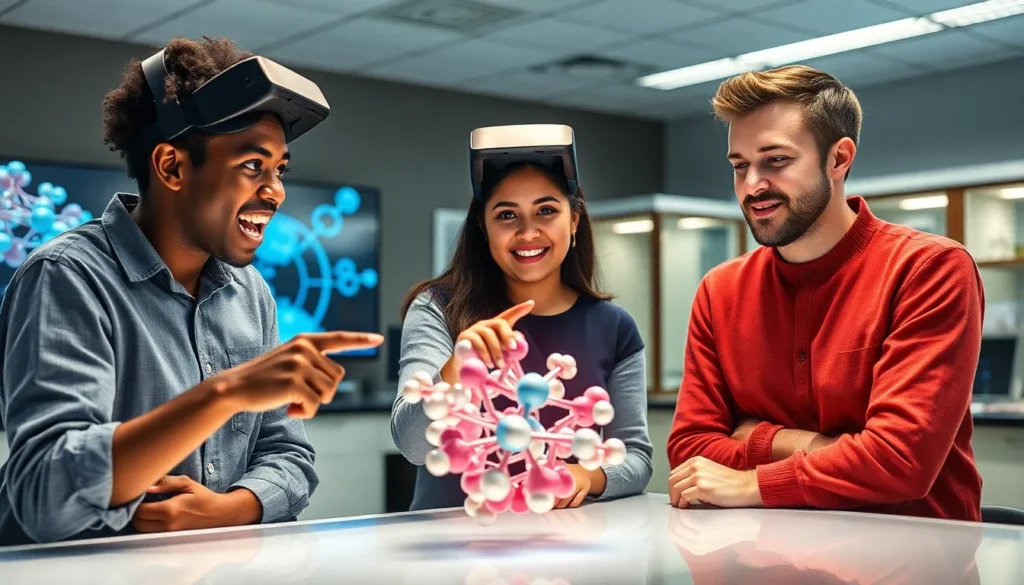

Imagine stepping into a world where science isn’t just a subject in textbooks but an interactive adventure that sparks curiosity. Welcome to the realm of AR labs for science, where augmented reality transforms the mundane into the extraordinary. Gone are the days of boring lectures and static diagrams; now, students can explore molecular structures or dissect virtual frogs without the mess.
Overview of AR Labs for Science
AR labs represent a revolutionary shift in science education. This technology enhances traditional learning methods by offering interactive and immersive experiences.
Definition of Augmented Reality
Augmented reality, or AR, seamlessly overlays digital information onto the physical environment. It integrates virtual elements in real time, allowing users to see both the real world and computer-generated graphics simultaneously. This interaction fosters deeper understanding of complex concepts. Educators utilize AR to explain intricate topics, enriching the learning experience. Applications span across various scientific disciplines, providing engaging methods for students to grasp material.
Importance of AR in Scientific Research
AR plays a critical role in advancing scientific research. Researchers use this technology to visualize data sets, facilitating better analysis and interpretation. It enhances collaboration across teams by allowing remote participants to engage with 3D models. Furthermore, AR applications enable simulations of experiments, reducing costs and risks associated with traditional methods. As a result, researchers can test hypotheses in a controlled setting. The technology significantly accelerates the pace of discoveries, leading to innovative solutions in various scientific fields.
Applications of AR Labs in Various Scientific Fields
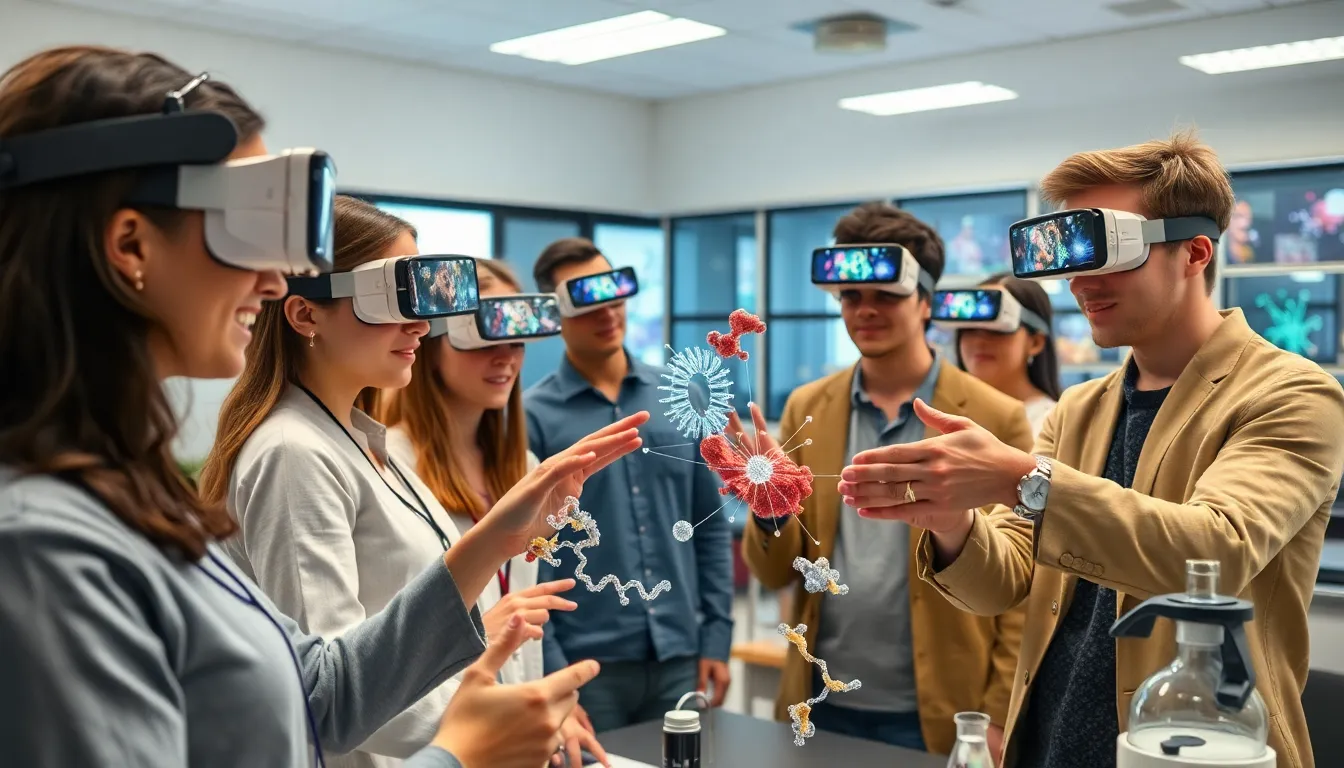
Augmented reality significantly enhances how various scientific fields operate. This technology creates immersive educational experiences that promote deeper understanding.
AR in Biology and Medicine
In biology, AR facilitates virtual dissections and 3D visualization of complex structures. Students engage with life-like models, increasing their retention of anatomical knowledge. Medical training benefits from AR by simulating surgeries without the risk associated with real-life procedures. By practicing on virtual patients, future doctors gain practical experience that enhances their skills and confidence. Research in biology also sees advancements through AR, which allows for detailed exploration of cellular processes in real-time.
AR in Chemistry and Materials Science
Chemistry education transforms with AR, where students visualize molecular interactions in three dimensions. Lab simulations help students safely conduct experiments without hazardous materials. Materials science leverages AR by allowing researchers to manipulate virtual models of compounds, facilitating the development of new materials. Interactive visualizations demonstrate the properties of substances, enabling a better understanding of reactions and their implications. This technology promotes collaboration among scientists, allowing them to share insights and findings more effectively.
AR in Environmental Science
Environmental science applications utilize AR to visualize complex ecosystems and the impacts of human activity. Field studies become interactive as students and researchers explore habitats through AR overlays. Data visualization enhances understanding of climate change by illustrating its effects on specific areas. This approach fosters a hands-on learning experience, making concepts such as biodiversity and conservation more tangible. Collaborative projects benefit from AR by allowing teams to visualize environmental changes and strategize accordingly.
Benefits of Using AR Labs for Science
AR labs offer numerous advantages that enhance the educational and research experience in scientific fields.
Enhanced Visualization and Learning
Augmented reality transforms complex scientific concepts into visual experiences. Students engage with 3D models, making it easier to grasp structures like molecules and anatomical systems. Interactive simulations enable learners to experiment with scientific phenomena in real-time. Retention improves as students visualize intricate details, experiencing subjects like biology and chemistry in immersive ways. Furthermore, AR facilitates virtual dissections, enabling anatomy students to explore without physical specimens. This technology appeals to diverse learning styles, ensuring an inclusive educational environment.
Improved Collaboration Among Researchers
Collaboration sees new heights with AR technology. Researchers, whether located in different cities or countries, can virtually interact within the same experimental space. Shared AR environments allow teams to manipulate data and visualizations collectively. Discussions develop more effectively, as participants can view real-time data alongside digital representations. This method enhances understanding and fosters innovation across various scientific projects. Ultimately, increased collaboration accelerates research timelines, enabling teams to reach new discoveries more efficiently.
Real-Time Data Analysis
Real-time data analysis becomes accessible through AR labs. Scientists can overlay data sets onto physical environments, facilitating immediate analysis of ongoing experiments. This capability streamlines processes and improves accuracy in research findings. Researchers quickly manipulate data, resulting in faster decision-making and enhanced productivity. AR helps visualize trends and patterns, making complex data easier to interpret. Overall, immediate access to analysis fosters timely insights, driving advancements in diverse scientific fields.
Challenges and Limitations of AR Labs
Augmented reality labs encounter several challenges that can hinder their effectiveness and accessibility. These obstacles need addressing for AR labs to maximize their potential in science education.
Technological Barriers
Technological limitations often impede the widespread use of AR labs. Limited access to high-speed internet affects users’ ability to engage fully with AR experiences. Inadequate hardware, such as smartphones or tablets, presents another challenge; devices with insufficient processing power can struggle to run advanced AR applications smoothly. Additionally, software compatibility issues may arise, particularly when integrating AR tools with existing educational platforms. Without resolving these technological barriers, implementing AR labs in educational settings remains difficult.
Cost Considerations
Implementing AR labs necessitates substantial financial investment. Developing high-quality AR content incurs development expenses that can be prohibitive for many institutions. Procurement of compatible devices continues to represent a significant cost, particularly for underfunded educational facilities. Maintenance and updates to AR software also require ongoing financial resources, which can strain budgets. Without addressing these cost considerations, institutions may hesitate to adopt AR technologies in their science programs.
User Adaptability
User adaptability plays a crucial role in the effectiveness of AR labs. Not all educators and students possess the necessary technical skills to navigate AR platforms confidently. Training programs must accompany AR implementation to ensure users can utilize the technology effectively and efficiently. Moreover, varied learning preferences among students can impact how well they adapt to AR methods. Those who favor traditional learning styles may face challenges when transitioning to an interactive environment. Addressing user adaptability requires focused efforts to provide support and training for all individuals involved in the educational process.
Future Trends in AR Labs for Science
Future trends in augmented reality labs for science promise to reshape educational landscapes and research methodologies. As technology evolves, new possibilities emerge that enhance learning and scientific endeavors.
Advancements in AR Technology
Improvements in AR technology enhance visual fidelity and interactivity. Enhanced graphics engines allow for more realistic 3D modeling, making simulations easier to understand. Integration of artificial intelligence personalizes learning experiences by adapting content based on user interactions. Moreover, advancements in hardware make AR equipment lighter and more accessible. Devices such as augmented reality glasses facilitate longer usage times while promoting user comfort. This combination of developments fosters an environment where students and researchers can fully leverage AR’s potential.
Potential Impact on Scientific Education
The integration of AR into scientific education can revolutionize pedagogical approaches. Engaging students through immersive experiences increases interest and participation in STEM disciplines. Enhanced visualization of abstract concepts facilitates deeper understanding and retention. Collaborative projects among students benefit from sharing virtual environments, promoting teamwork and innovation. Educators can utilize real-time feedback from AR tools to tailor instructions to individual student needs. This transformation in scientific education cultivates a generation equipped with the skills necessary for future advancements.
AR labs are paving the way for a new era in science education and research. By transforming how students interact with complex concepts AR technology fosters a deeper understanding and engagement that traditional methods often lack. The immersive experiences offered through AR not only enhance learning but also promote collaboration among researchers, leading to innovative solutions in various scientific fields.
While challenges exist in terms of accessibility and adaptability addressing these issues will be crucial for maximizing AR’s potential. As advancements continue to emerge the future of AR in science education looks promising. By embracing this technology educators and institutions can cultivate a generation of learners equipped with the skills necessary for the scientific advancements of tomorrow.


